Transcendent – Connecting Across Lifetimes
Transcendent – Connecting Across Lifetimes

Written by
Chris Saunders, Adult Adoptee and Attorney
Published on:
Sep 30, 2026
Category
Lived Experience

She sits with me. Silence is thick and heavy, comforting in its finality if I don’t think about it for too long and linger on what I lost. Or what I’ve found. “Happy Mother’s Day, it’s nice to meet you,” I say to my biological mother for the first time in my life. I place her urn on a shelf in my living room.
I was 39 when I discovered I was adopted. About one year ago today. My adoptive parents believed they were doing the right thing by not telling me, and they never intended to. Most days I understand the logic. Other days I struggle deeply to find forgiveness for the debased disregard for the feelings of a human being they claimed to love. However, every day I draw warmth and strength from the community I stumbled upon in C.A.S.E.’s Adult Adoptee Support Group.
Some things follow you even when you don’t know they are there—waiting for you to find them.
I’ve lived in South Florida for exactly half of my life. I was born and raised in Boston, Massachusetts. I did not grow up in the safest neighborhood (my parents forbid me from playing outside), but I loved my city. I still call it home. But I knew I wanted to leave when it came time to go to college. Through some twists and turns, I ended up at the University of Florida (UF), which has ultimately been the single best decision of my entire life, and led to me permanently relocating to Florida. It’s cliché, but I truly did begin to find myself at UF. I struggled, though. My parents’ marriage fell apart my sophomore year, the fallout of which led to eviction from my apartment because it sent my mother’s gambling addiction into overdrive (my parents told me not to find a job so I could focus on school). I couch surfed for months until I was able to find a job and get a place of my own. One of the couches I landed on was in the apartment of the girl I now am blessed to call my wife.
I received a text from an unknown number late at night on July 20, 2025.
“Do you know who your real blood parents are? You have no drop of Saunders blood in you. Or your kids. Your mom was a college student who got pregnant and could not take responsibility of a child and gave you up for adoption.”
I had just returned to our South Florida home from a soccer camp in Georgia with my oldest daughter and my father who came down from Massachusetts. There were several misspellings in the text message so I thought it might be a phishing scam. I didn’t even tell my wife until we were getting ready for bed. But something told me to check the area code of the number that sent the text message: Maryland. The hair rose on the back of my neck.
I had a sister in Maryland, my father’s daughter from a previous marriage. I hadn’t seen or spoken to her in probably 30 years. She’s much older than me, we never lived together and were never close. I’m not even sure how she could have obtained my number. She was known to be a generally toxic human being. I thought to myself, “If anybody was going to tell family business, it was going to be her.”
I went to sleep, resolved to talk to my father the following morning.
I called my father on the way to work. I told him I needed him to do something for me without asking any questions. He agreed. I asked him what phone number he had for my sister. He gave me two numbers. The first one wasn’t a match. The second one was. So, I told him that I was going to tell him what she sent me, and that I wasn’t sure how to feel about it, or if I even cared it was true. I read him the text verbatim. He said, “Well I’m really glad you don’t care.” My reaction was not instant.
I told him I loved him anyway, and that it probably wasn’t going to change much. Inside, I felt the upswell of gravity losing its hold on the axis of my life. I wouldn’t have much time to sit with the sound of the earth’s core cracking inside my head as my mother was on a flight to Florida to visit for her birthday that same day. The ride home from the airport was going to be…eventful.
That day set me on the course to where I am today. I was standing in my kitchen on the morning of Mother’s Day 2026 when I discovered my biological mother had passed and was cremated. I was consumed by two things: 1) learning everything about her and 2) bringing her home. This journey would not have been possible without the incredible support from fellow adult adoptees Rachel, Tony, and the stories everyone in the C.A.S.E. Adult Adoptee support group have shared. I spoke to Rachel the day before I met with most of my only living cousins, who had my mother’s ashes and graciously allowed me to reunite with her.
I assume my sister sent that text with the intent of breaking me, and potentially out of jealousy of the connection I had with my father, or long-harbored resentment about the fact that he moved on from her mother. Instead, it became one of the greatest gifts of my life. I know the conventional trope that adoptees are supposed to be grateful for the lives they were “given” by their adoptive families — an attempt to romanticize the trauma of being adopted and sanitize the immutable truth that adoptive parents may be no better than biological ones. I love my parents. Their relationship was perpetually strained at best, domestically abusive at worst. I love myself (as much as I can) but I also grew up with deep depression, suicidal ideation, and grieving the loss of close friends that died in their teens and twenties. My happiness was learned, practiced, and bled for. Amid the struggle at times to simply keep myself from ending it all, I (oftentimes subconsciously) engaged in a bare-knuckle brawl to hold on to hope and find the resilience I now know comes from the woman that gave birth to me.
That text was the beginning chapter of me realizing how much I’d won. I’ve experienced the intense loneliness of feeling like no one truly could understand this moment in my life, but I also have never felt more loved in my life. I’ve learned about the depth of the torment my biological mother experienced in making her decision, a torment she endured until she died. I carry the warmth of the embrace of all my biological cousins when I walked into their home the day before Mother’s Day to meet them for the first time.
Through letters she wrote me and my conversations with her best friend, I walk with the knowledge that my biological mother, a survivor of sexual abuse, group homes, and schizophrenia, did what she thought gave me the best opportunity to write my own legacy. She celebrated my birthday every year. I mourn the belief that my adoption defined her life. She never had other children, was a familiar face at mental health institutions, battled alcoholism, and died alone in an apartment after suffering seizures. I glow at the sight of my own children who unknowingly continued a family tradition – my biological mother was a gifted figure skater and my middle daughter fell in love with it at 6 years old (my son is a hockey player and my oldest daughter’s first hockey season is this summer).
My wife and my closest friends helped me search for my roots, listened, and empathized. While they made grave mistakes, my adoptive parents did their absolute best to support me throughout my life, and in their own way, and have attempted to make space to talk about the uncomfortable truths around the secret they kept from me. In so many ways, this moment deepened the connections I have with the people who have me. I hugged my mother’s urn so tightly when I had my first moment alone, a knowingly futile attempt to let her feel what I now felt because of her.
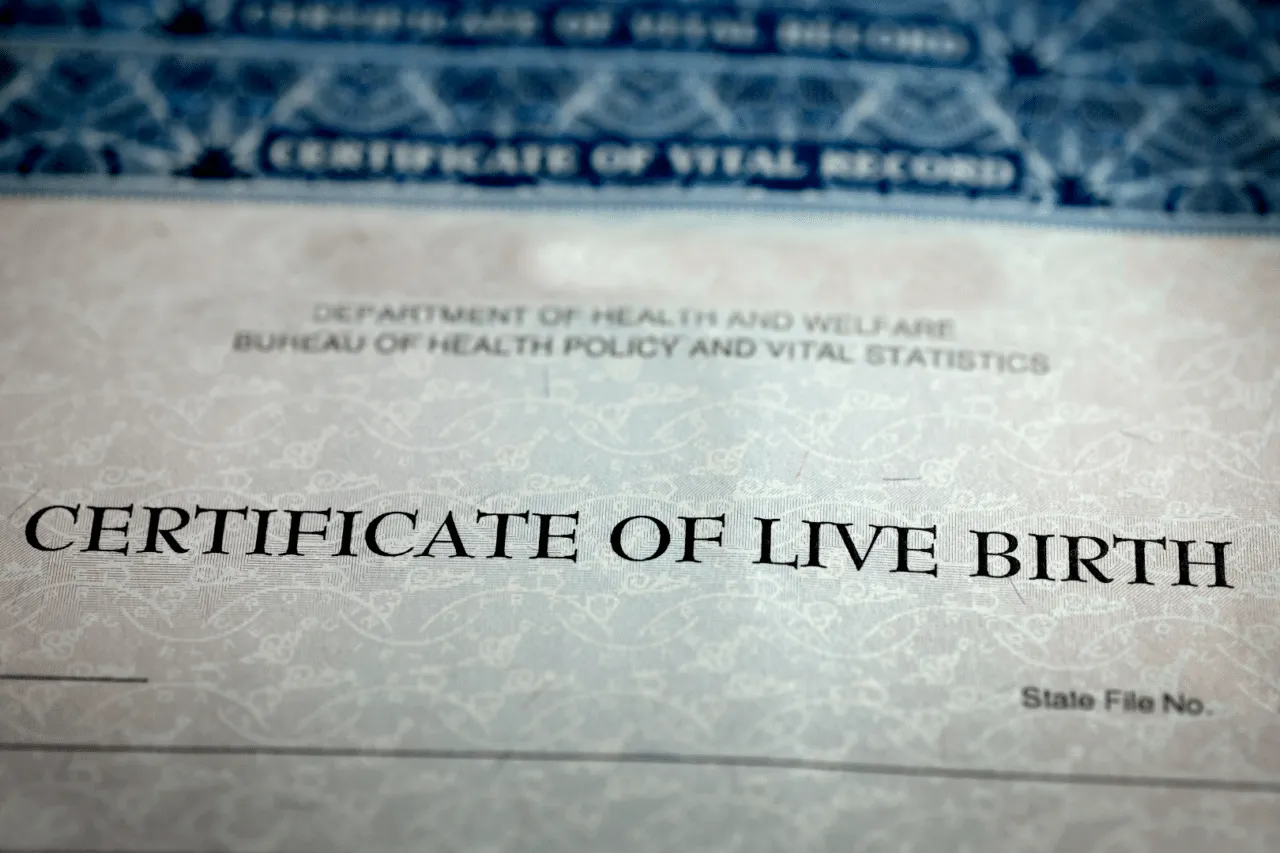
Last August, I flew to Boston to begin learning my own story. I applied to receive my pre-adoption birth certificate. I picked up two copies. I sat in the rental car and opened the folder they’d given me. In addition to learning the name my mother had given me, I read the address my mother had put down at the time I was born. I looked it up. It was the north campus to Salem State University. She graduated from there and eventually got a master’s in social work, helping families in similar circumstances to her own.
Salem State’s colors are orange and blue. The same colors as the University of Florida.
Chris Saunders is a husband, father of 3, and a late discovery adoptee. He is a Boston, MA native who has been living in South Florida since 2010. He is a practicing attorney and active in civic and community organization around the region. In addition to spending time with his family, he enjoys playing hockey, soccer, camping, obstacle course races, and going to concerts.